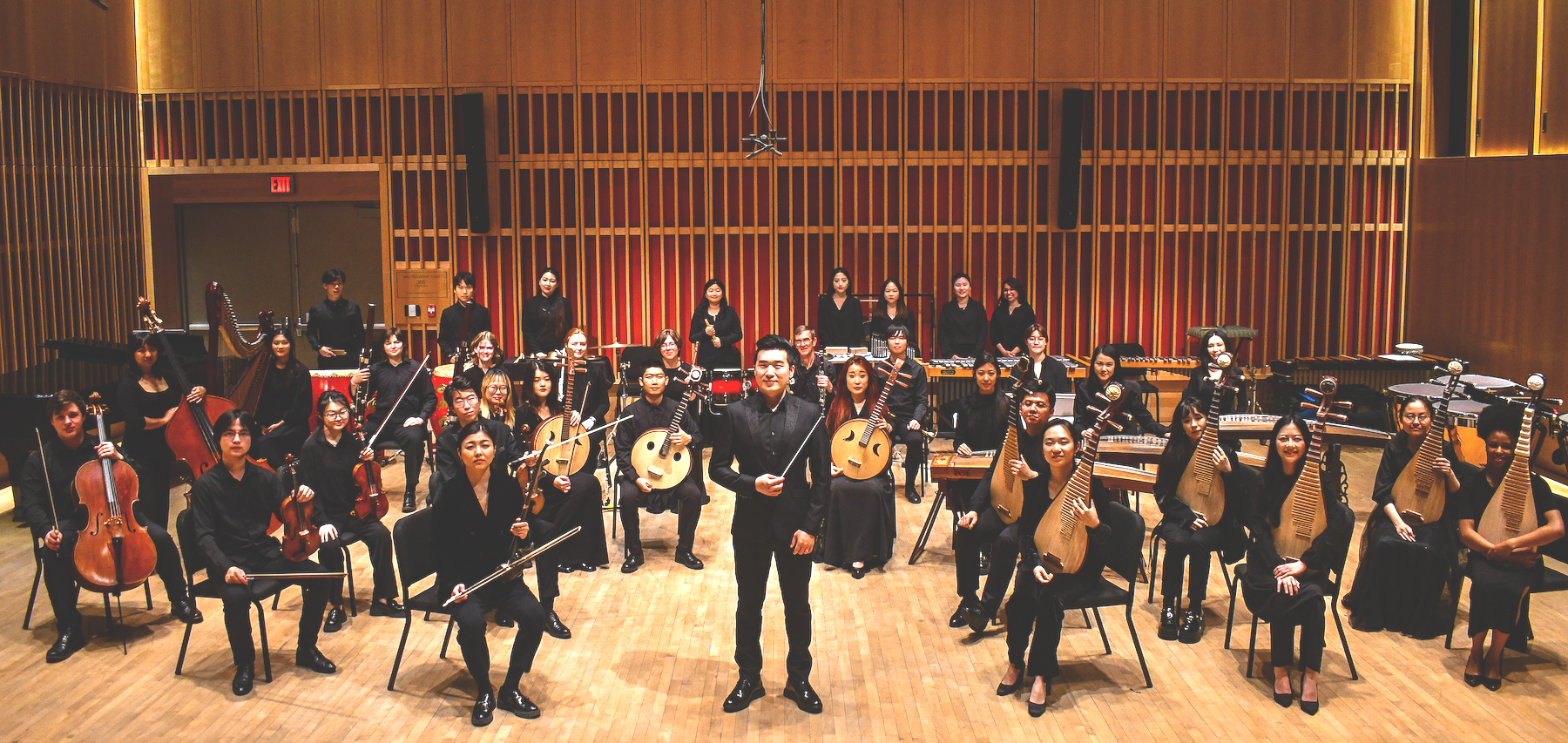
The Bard Chinese Ensemble pays tribute to its beloved music director Shutong Li 李梳曈 after his sudden passing in February. US-China Music Institute director Jindong Cai will conduct.
Free and open to the public.
Livestream on Youtube at: youtube.com/live/vUX2qLWqSrk
program
Abing 阿炳
The Moon Reflected on Erquan Pond 《二泉映月》
Beitong Liu, erhu
Ning Yong 宁勇
Camel Bells Along the Silk Road concerto for ruan and orchestra 《丝路驼铃》中阮协奏曲
arr. Zhou Yuguo 周煜国/Shutong Li 李梳曈
Yuling Nan, ruan
Liu Xijin 刘锡津
Echoes from the Maritime Silk Road concerto for konghou 《丝海流音》箜篌协奏曲
arr. Shutong Li 李梳曈
Kexilin Ke and Jiayi Sun, konghou
Wang Danhong 王丹红
Four Seasons in Lingering Garden symphonic poem 《四季留园》
arr. Shutong Li 李梳曈
Charles Ives
The Unanswered Question
Shutong li — remembering a life in music
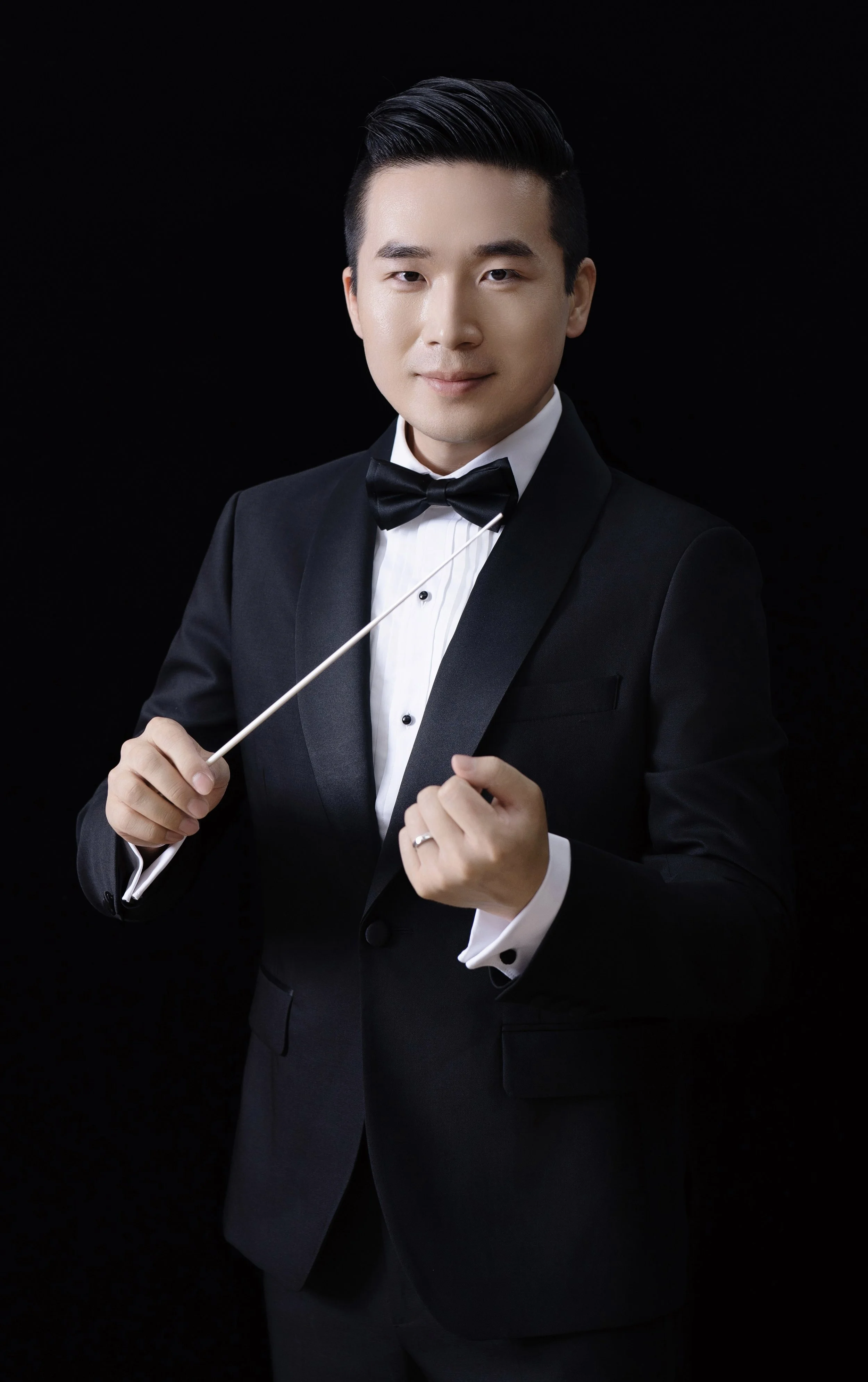
Shutong Li was born in 1990 in Ordos, Inner Mongolia, China. A devoted musician and conductor, he dedicated his life to building musical bridges between cultures and communities. He served as Music Director of the Chinese Ensemble at the US-China Music Institute of the Bard Conservatory of Music, and as Assistant Conductor of the China Now Music Festival and the Bard East-West Ensemble, where he championed dialogue between Eastern and Western musical traditions.
After earning an undergraduate degree in Industrial Engineering from Dalian Minzu University, Li followed his lifelong passion for music to the United States, receiving a Bachelor of Music from the University of New Mexico. There, he founded Musicians For Musicians (2017–2019), organizing 19 projects and 38 concerts that created meaningful opportunities for more than fifty young artists. In 2021, he earned a Master’s degree in Conducting from the Bard College Conservatory of Music. He joined the US-China Music Institute at Bard as a conductor the following year.
At Bard and in the New York region, he conducted nearly 40 concerts and opera productions. He collaborated with numerous professional ensembles across Asia, Europe, and the United States. Li believed deeply in music’s power to connect people, and his kindness, vision, and artistry will live on in the music and the lives he touched.

-
Remembering Shutong Li
Jindong Cai, Director of the US-China Music Institute
February 21, 2026
Ten days ago, on Wednesday, I was in the first rehearsal with The Orchestra Now for this year’s Chinese New Year Concert. Shutong was behind me, as he so often was, quietly assisting, listening to every note. I asked him about balance—especially the singing line of the pipa above the orchestra, not to be swallowed by the orchestra. After rehearsal, we discussed more things about the music, especially how to guide our percussion players in learning the technique of playing Chinese drums and gongs. We also talked about his other rehearsal that evening with the Chinese Ensemble.
We shook hands. I said, “See you tomorrow.” Tomorrow never came.
To me, and to the Bard US-China Music Institute, Shutong was indispensable. But that word feels too small. He did far more than fulfill his responsibilities; he animated them. He was our most enthusiastic spirit, our most inventive mind.
The Institute is the first comprehensive Chinese music institution in the West. We were building something unprecedented—something without a blueprint. That meant constant improvisation, especially in supporting students majoring in Chinese instruments within a largely Western conservatory environment. Shutong was uniquely equipped for this challenge. In less than two years, he transformed the ensemble. What had once struggled—with repertoire, with maintaining players, with drawing audiences — became vibrant and confident: a full ensemble of Chinese and Western instruments, adventurous programs, and concerts filled to capacity. He reached out to Western instrumentalists and invited them into the ensemble. He collaborated with contemporary composers and soloists. He spoke to audiences with clarity and cultural context, helping them not only hear the music but understand its soul.
Shutong was a conductor, composer, arranger, and producer—each role needing his imagination. He had a great gift for discovering powerful works, shaping them to our needs, preparing parts and scores, promoting concerts tirelessly, and speaking directly to audiences with sincerity. He did not simply organize performances; he created experiences.
His loss is immeasurable. It is difficult to imagine finding another person with his combination of artistry, dedication, generosity, and vision.
Shutong was a remarkable musician, a wonderful colleague, a dearest friend. I also saw him as a loving son, husband, and father. There are no words that can even come near to express the depth of sorrow for what has happened to him and to his family. All of us—students, faculty, colleagues—at the US-China Music Institute at Bard College Conservatory share this grief.
Last weekend, during our Chinese New Year Concerts at the Rose Theater in Lincoln Center, I told the audience what happened and that we will play with heavy hearts, but with Shutong’s spirit beside us. I had a profound feeling in the way our musicians played, in the intensity and tenderness.
When I took the final bow to the completely filled hall at Rose Theater, I bowed not only to the audience, but also to Shutong in heaven. I wanted him to hear the music. And in that moment, I made a silent promise to him: that we will continue the work we began together—to carry Chinese music forward, to share it with the world.
In Olin Hall in 2023. Photo by Karl Rabe.
Conducting the ensemble in 2024. Photo by Aya Rebai.
With the Bard East/West Ensemble at Jazz at Lincoln Center in 2025. Photo by Fadi Kheir.
ABOUT THE SOLOISTS
Beitong Liu holds a Bachelor's degree in erhu performance and an MA in Chinese music and culture from Bard Conservatory’s US-China Music Institute. She is known for her cross-genre versatility, spanning traditional Chinese music, jazz, contemporary works, and improvisation. A 2023–24 Bespoken Fellow, she won First Prize in the 2024 Singapore Star Erhu Competition and the 2025 Music International Grand Prix in the World Music category. She is also the co-founder of Bright Moon and Echos of China, and actively promotes cultural exchange through music education.
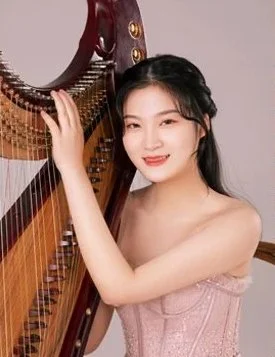
Kexilin Ke began studying the Konghou at an early age and has been a student of Professor Cui Junzhi ever since. She performed alongside Cui at the State Council's Spring Festival Gathering, where they played for President Xi Jinping and other national leaders. She also performed as a soloist with the Bard East/West Ensemble during their tour of China in 2025. Ke is in her third year majoring in konghou performance at the US-China Music Institute.
Jiayi Sun is in her 3rd year at Bard pursuing a dual degree in konghou performance and economics. She began her formal musical training at the age of ten with classical piano, developing a strong foundation in music theory, technical proficiency, and interpretive performance. At sixteen, she shifted her primary focus to the konghou, a traditional Chinese harp, and has since dedicated herself to advancing its artistic and expressive possibilities. She currently studies under Professor Junzhi Cui, engaging with both traditional repertoire and contemporary works that expand the instrument’s modern concert presence. Sun is the recipient of the Gold Prize at the 2024 Asian International Arts Festival.
Yuling Nan is an emerging music scholar and ruan performer dedicated to musical arts and cross-cultural research. She is currently pursuing a Master’s degree in Chinese music and culture at the Bard College Conservatory of Music. She earned a dual Bachelor’s degree from Bard College, majoring in ruan performance and Asian studies, and studied ruan under Professor Xu Yang of the Central Conservatory of Music. Her research focuses on musical iconography in Dunhuang, Silk Road music culture, and Sino-Western musical exchange. She is a Gold Award recipient of the Nanyang International Music Competition.
ABOUT THE BARD CHINESE ENSEMBLE
The Bard Chinese Ensemble is the Bard Conservatory’s large mixed ensemble of Chinese and Western instrument players. Every year the instrumentation changes so that students of various different Western instruments have the opportunity to experience the unique technical and artistic challenges of playing alongside traditional Chinese instruments.
Each performance features specially arranged music from China. In addition to re-arranging traditional works from the Chinese orchestral repertoire, Music Director Shutong Li worked with contemporary living composers to adapt new works to the ensemble’s unique instrumentation, offering audiences the opportunity to hear some of the finest and least often performed orchestral music of our time.